Risk Calculators
Resources
Educational only, not medical advice.Most Americans think of STDs as something that happens to other people. The reality, backed by nearly two decades of federal lab data, is that sexually transmitted infections are staggeringly common, and the vast majority of people who have them have never been diagnosed.
We analyzed blood test results from 97,683 participants in the CDC's National Health and Nutrition Examination Survey (NHANES) spanning 2005 through 2023 to quantify just how wide the gap is between actual infection rates and diagnosis rates for five major STDs: HSV-1, HSV-2, Hepatitis C, Hepatitis B, and HIV.
The results are sobering.
In a Room of 100 Americans, How Many Are Infected?
To put these numbers in perspective, imagine a room of 100 randomly selected American adults. For each disease, here's how many people in that room would test positive, and how many of those would have any idea they're infected.
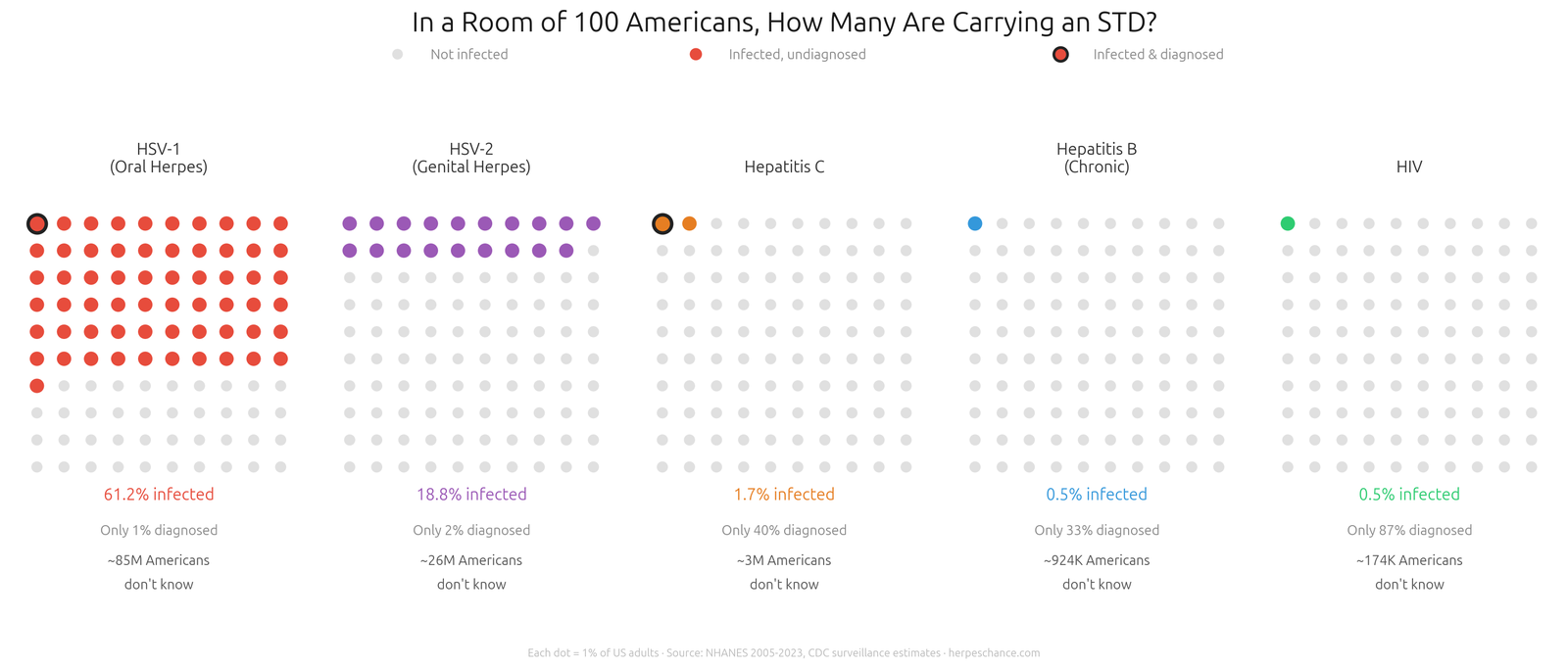
The HSV-1 panel is striking: 61 out of every 100 adults carry oral herpes, yet only about 1 in 100 of those infected have ever been told they have genital herpes. HSV-2, the primary cause of genital herpes, infects roughly 19 out of 100 adults, and again, only about 2% of those people know.
For Hepatitis C, about 2 in 100 are infected but 40% have been diagnosed, largely due to the CDC's recommendation that all Baby Boomers get screened. HIV has the best diagnosis rate at 87%, the result of decades of public health investment in testing infrastructure.
The Scale of What We're Missing
When you translate these percentages into actual people, the numbers are staggering. The chart below shows the estimated number of Americans living with each infection, split into those who have been diagnosed and those who haven't.
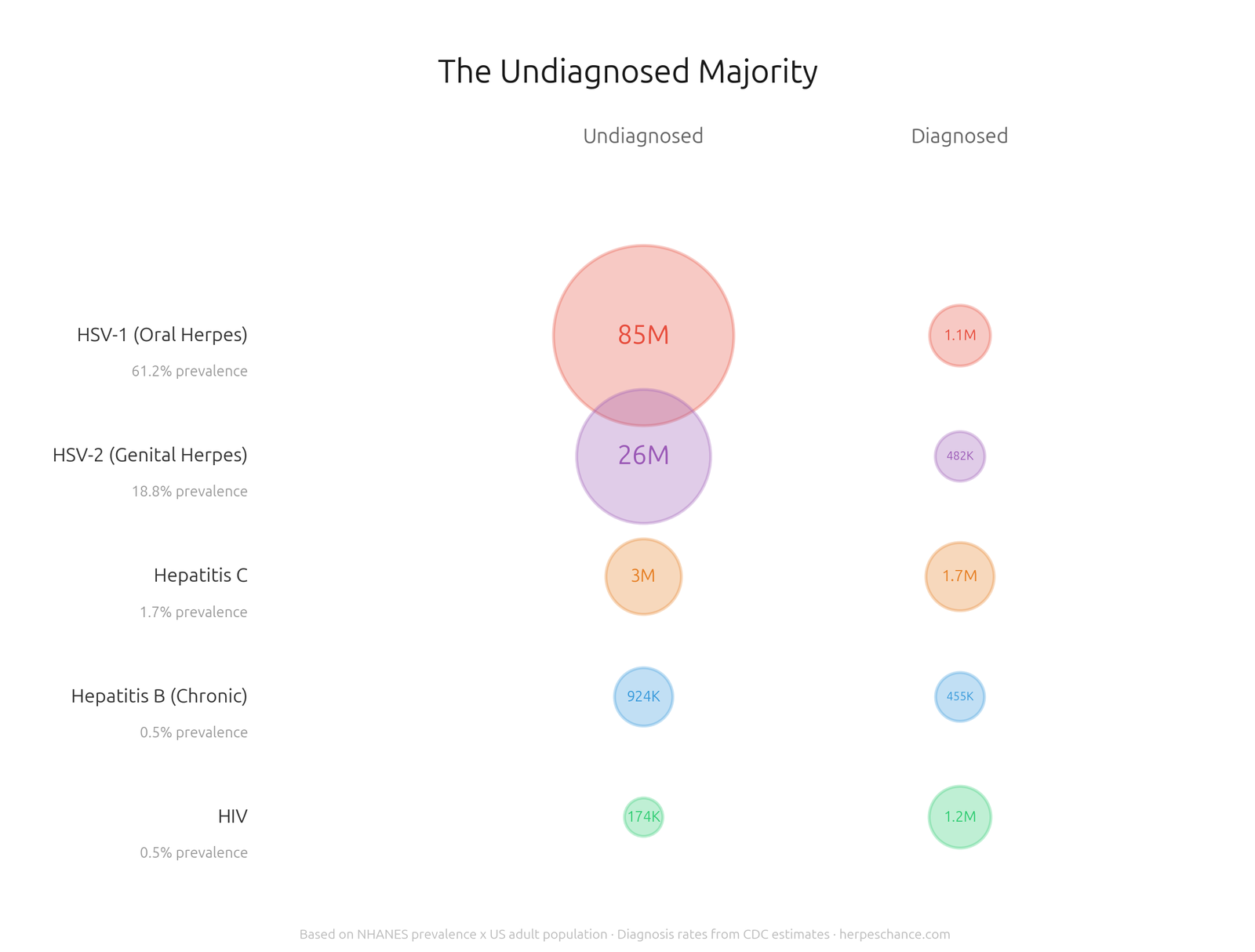
The HSV-1 undiagnosed bubble, representing approximately 85 million Americans. That dwarfs everything else on the chart. That's roughly one in three US adults walking around with an active herpes virus they don't know about.
But the smaller bubbles tell important stories too. Nearly 26 million Americans have genital herpes (HSV-2) without knowing it. About 3 million are living with undiagnosed Hepatitis C, a disease that can silently destroy the liver over decades before symptoms appear.
Several factors drive the diagnosis gap:
- No routine screening: The CDC does not recommend routine herpes screening for asymptomatic people. Most standard STD panels don't include HSV testing.
- Asymptomatic infection: Up to 80% of people with HSV-2 and most people with HSV-1 never develop recognizable symptoms.
- Stigma: Many providers avoid testing for herpes specifically because a positive result causes psychological distress in patients who may never have an outbreak.
- Mild symptoms mistaken for something else: Minor outbreaks are often dismissed as ingrown hairs, razor burn, or yeast infections.
What This Means for You
If you're sexually active, the statistics suggest there's a meaningful chance you've been exposed to at least one of these infections, particularly HSV-1, which the majority of American adults carry.
The good news: knowledge is power. Knowing your status lets you make informed decisions about your health and your partners' health. Modern antiviral medications can reduce herpes transmission by up to 48%, and Hepatitis C is now curable in over 95% of cases with direct-acting antivirals.
Find Out Where You Stand
Our risk calculators use the same NHANES data shown above to estimate your personal probability of carrying each infection based on your demographics and risk factors.
Take the Full STD PanelYou can also check individual diseases:
- HSV-1 (Oral Herpes) Risk Estimator
- HSV-2 (Genital Herpes) Risk Estimator
- Hepatitis C Risk Estimator
- Hepatitis B Risk Estimator
- HPV Risk Estimator
Getting Tested
If you want certainty rather than probabilities, getting tested is the only way to know for sure. We've put together a comprehensive guide to every STD testing option available in 2026, including at-home test kits, Planned Parenthood, community health centers, and telehealth services.
For herpes specifically, make sure you request an IgG type-specific blood test. The standard IgM test is unreliable and not recommended by the CDC.
Methodology
All prevalence estimates in this article are based on our analysis of 97,683 participants across nine cycles of the CDC's National Health and Nutrition Examination Survey (NHANES), spanning 2005 through 2023. NHANES uses a complex, stratified, multistage probability sampling design to produce nationally representative estimates of the US civilian noninstitutionalized population.
How Infections Were Determined
Infection status for each disease was determined by laboratory blood tests (serology), not self-report:
- HSV-1 and HSV-2: Type-specific IgG antibody testing (glycoprotein gG-based). Available for ages 14-49 across cycles 2005-2016 (variables LBXHE1, LBXHE2).
- Hepatitis C: Anti-HCV antibody screening, with RNA confirmation for positive screens. Variables LBDHCV (2005-2012), LBXHCR (2013-2016), and LBDHCI (2017-2023). Screening negatives (LBDHCI=3) were correctly classified as uninfected.
- Hepatitis B (chronic): Hepatitis B surface antigen (HBsAg) for current/chronic infection status (variable LBXHBS). This measures active carriage, not past resolved infection or vaccination immunity.
- HIV: HIV-1/HIV-2 antibody and p24 antigen combination assay (variable LBDHI).
How Diagnosis/Awareness Rates Were Estimated
Diagnosis awareness was measured differently depending on the disease:
- HSV-1 and HSV-2: Participants who tested seropositive by blood test were cross-referenced with the NHANES sexual health questionnaire item “Has a doctor or health care provider ever told you that you had genital herpes?” (variable SXQ260). The percentage of seropositive individuals answering “yes” gives the self-reported diagnosis rate. For HSV-1, this is approximately 1.3%; for HSV-2, approximately 1.8%. Note: this question specifically asks about genital herpes, so oral HSV-1 diagnoses may not be captured, meaning actual awareness could be somewhat higher.
- Hepatitis C (40% aware): Based on CDC surveillance estimates. The CDC reports that approximately 40% of people living with Hepatitis C have been diagnosed, reflecting improvements from the universal Baby Boomer screening recommendation issued in 2012.
- Hepatitis B (33% aware): Based on CDC estimates that approximately two-thirds of people with chronic HBV infection in the US are unaware of their status.
- HIV (87% aware): Based on CDC HIV surveillance data, which estimates that 87% of people living with HIV in the United States have received a diagnosis.
Population Estimates
US case counts were calculated by applying NHANES prevalence rates to population denominators:
- HSV-1 and HSV-2: Applied to approximately 140 million US adults aged 18-49 (matching the NHANES HSV testing age range).
- HCV, HBV, HIV: Applied to approximately 258 million US adults aged 18+ (US Census Bureau estimate).
Limitations
- NHANES prevalence estimates in this analysis are unweighted. Applying NHANES survey design weights may produce slightly different point estimates, though differences are typically small for common outcomes.
- HSV testing in NHANES is restricted to ages 14-49; prevalence in older adults is likely higher based on cumulative lifetime exposure.
- The NHANES “ever told genital herpes” question likely underestimates HSV-1 awareness, since many people with oral HSV-1 (cold sores) may know their status but would answer “no” to a question about genital herpes.
- Diagnosis rates for HCV, HBV, and HIV are CDC population-level estimates, not measured directly from the NHANES sample.
- NHANES excludes institutionalized populations (prisons, nursing homes), which may have different STD prevalence profiles.
Sources
- Centers for Disease Control and Prevention. National Health and Nutrition Examination Survey (NHANES). Continuous cycles 2005-2006 through 2021-2023. cdc.gov/nchs/nhanes
- McQuillan G, Kruszon-Moran D, Flagg EW, Paulose-Ram R. Prevalence of herpes simplex virus type 1 and type 2 in persons aged 14-49: United States, 2015-2016. NCHS Data Brief, No. 304. February 2018.
- Centers for Disease Control and Prevention. Viral Hepatitis Surveillance Report, United States, 2021. cdc.gov/hepatitis/statistics
- Centers for Disease Control and Prevention. Estimated HIV Incidence and Prevalence in the United States, 2017-2021. HIV Surveillance Supplemental Report. 2023.
- Hofmeister MG, Rosenthal EM, Barker LK, et al. Estimating prevalence of hepatitis C virus infection in the United States, 2013-2016. Hepatology. 2019;69(3):1020-1031.
- Roberts H, Kruszon-Moran D, Ly KN, et al. Prevalence of chronic hepatitis B virus (HBV) infection in U.S. households: NHANES, 1988-2012. Hepatology. 2016;63(2):388-397.
Check Your Risk
Use our evidence-based calculators to estimate your personal STD risk.